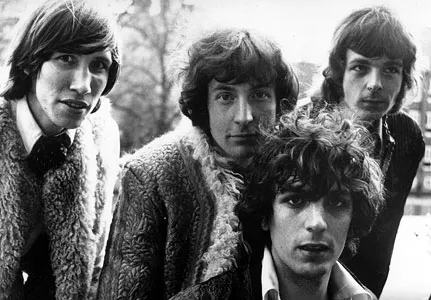
Formed in London in 1965, Pink Floyd became one of rock’s most influential and successful bands. Initially led by guitarist and songwriter Syd Barrett, the group emerged as one of the leading figures of the British psychedelic scene. Over time, it developed longer, more experimental, and conceptual compositions, becoming a pillar of progressive rock and art rock.
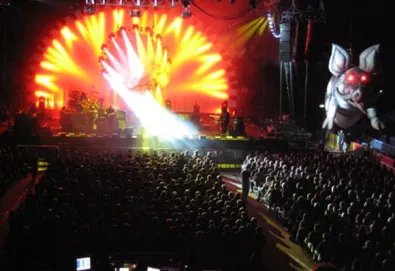
The group also stood out for its grandiose performances, which pioneered the use of projections, stage lighting, advanced sound systems, and theatrical elements. Rather than focusing solely on the musicians’ movements, the shows sought to create immersive audiovisual experiences in which music, imagery, and stage design merged.
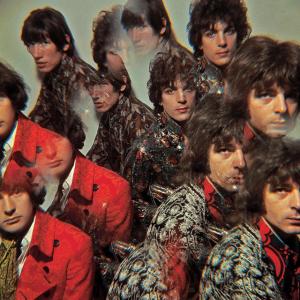
The band’s name was conceived by Barrett based on two American blues musicians he admired: Pink Anderson and Floyd Council. As the principal creative force behind this early phase, Barrett wrote most of the debut album, The Piper at the Gates of Dawn (1967).
Toward the end of that year, in light of Barrett’s erratic behavior and his growing difficulties in the studio and on stage, David Gilmour joined the group. Pink Floyd briefly had five members until Barrett’s permanent departure in 1968. Although the use of psychedelic substances is often associated with the worsening of his condition, the exact causes of his mental decline have never been conclusively determined.
With its classic lineup—David Gilmour (guitar and vocals), Roger Waters (bass and vocals), Richard Wright (keyboards and vocals), and Nick Mason (drums)—the band reached its artistic and commercial peak. This phase gave rise to seminal works such as The Dark Side of the Moon (1973), Wish You Were Here (1975), Animals (1977) and The Wall (1979). Waters gradually took on the role of principal lyricist and conceptualist, while Gilmour and Wright shaped the band’s sound.
Internal tensions escalated in The Wall and culminated in The Final Cut (1983), an album dominated by Waters. In 1985, the bassist left the group, believing the project had run its course. However, Gilmour and Mason decided to continue using the name, sparking a legal dispute that was settled out of court. Wright, who had been fired during The Wall, returned first as a session musician and later as an official member.
Without Waters, the band released A Momentary Lapse of Reason (1987) and The Division Bell (1994), accompanied by spectacular world tours. On July 2, 2005, the classic lineup reunited for the last time at the Live 8 charity concert in Hyde Park, London, marking the first time the four musicians had performed together in over two decades.
Syd Barrett passed away in 2006 at the age of 60, and Richard Wright in 2008 at the age of 65. In tribute to the keyboardist, Gilmour and Mason released The Endless River, the band’s 15th and final studio album. Created from recordings made with Wright during the sessions for The Division Bell, the album is almost entirely instrumental and serves as a tribute to his legacy.
In 2022, Gilmour and Mason reunited exceptionally to release the charity single “Hey Hey Rise Up,” recorded in support of Ukraine and featuring vocals by Ukrainian singer Andriy Khlyvnyuk (of the band Boombox). Although it was the first new material in nearly three decades, The Endless River remains the final chapter in the studio discography of Pink Floyd.
- Origin:
Featured Albums